
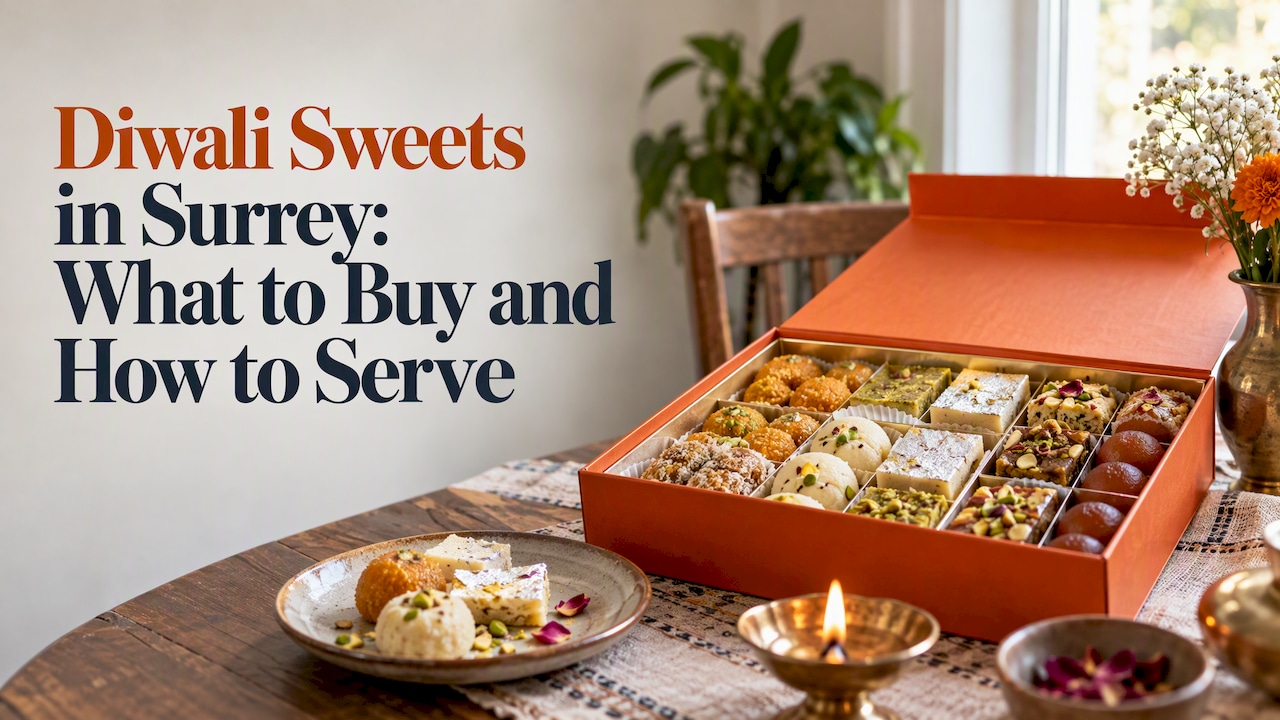
If you are looking for Diwali sweets in Surrey, start with the classics: gulab jamun, kaju barfi, milk cake, laddu and, for some families, ghevar. Order from a mithai shop a few days ahead, because the festival weeks are busy. Then build the rest of the table around them with something savory and hot, so the sweets are not doing all the work. This guide covers what each sweet is, how to choose quantities, what to ask a shop, and how to keep a table of sweets safe.
We are a street food restaurant, not a sweet shop, and we will say so plainly. What we do know is how Surrey families and event hosts put a Diwali table together, and how savory dishes and sweets work side by side.
ApnachaatAdd Savory Street Food to DiwaliApnachaat caters events in Surrey, bringing authentic Indian street food to your gathering alongside the sweets.Visit Apnachaat
TL;DR
- The Diwali staples are gulab jamun, kaju barfi, milk cake, laddu and halwa. Ghevar is a Rajasthani specialty tied to other festivals but sold by some shops.
- Order sweets by weight, ahead of time, and ask what is made fresh that week. Ask about nuts, dairy and sugar levels before you buy.
- For a gathering, plan one or two pieces of sweet per guest, plus savory dishes so the sweets stay a finale.
- Keep perishable sweets cold, use serving tongs, and refrigerate leftovers promptly, following Health Canada guidance.
- For the savory side of your Diwali table, we cater events and offer dine-in and takeaway in Surrey.
Table of Contents
- What Diwali sweets are, and why they matter
- The sweets you will see most in Surrey
- What is ghevar, and when is it eaten?
- Questions to ask before you buy
- How much to order: a practical guide for families and hosts
- Building the rest of the table
- Serving and storing sweets safely
- Our perspective: sweets and savory belong together
- Catering your Diwali gathering with us
- Dietary needs and sweets
- FAQ
- Sources
What Diwali sweets are, and why they matter
The sweets are called mithai, and they are more than dessert. The Michelin Guide describes mithai as an integral cultural component, often offered first to deities during prayer and then shared with family, friends and neighbors. That sharing explains the boxes: people do not buy one sweet for themselves, they buy an assortment to give away and to put out for visitors.
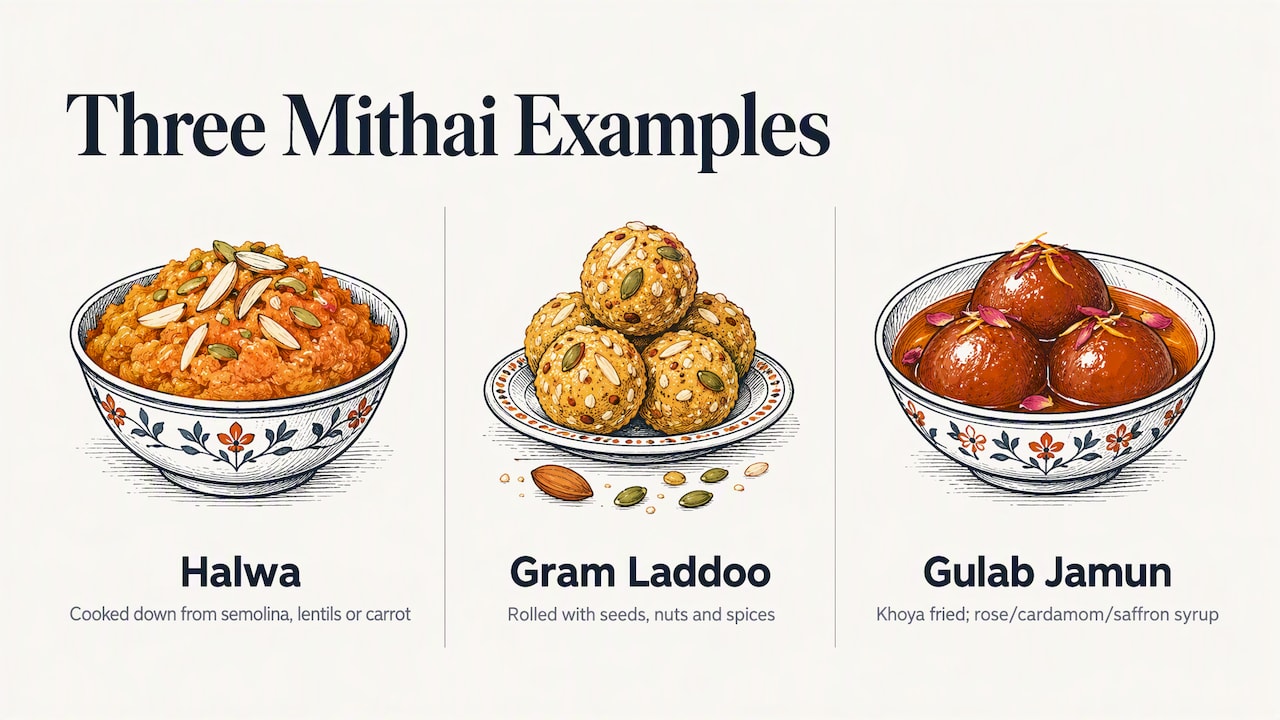
Most mithai are built on a base of nuts, vegetables, flour, lentils or milk, cooked down with sugar. Discovery’s guide to Diwali traditions gives a few examples: halwa, gram-flour laddoo rolled with seeds, nuts and spices, and gulab jamun made from khoya, fried and soaked in a syrup of rose, cardamom or saffron.
Diwali falls in October or November and moves each year with the lunar calendar. Check a current calendar for the exact day, then count back at least a week to place your order.
The sweets you will see most in Surrey
Local reporting gives a useful picture of demand. CBC spoke with a manager at a Surrey sweet shop ahead of Diwali, and the shop’s best sellers were gulab jamun, kaju barfi and milk cake. The same story notes that cashews and almonds are bought alongside sweets, partly for people who do not eat many sweets or know much about them.
Here is what each one is, so you can order with confidence.
| Sweet | What it is | Texture and taste | Good to know |
|---|---|---|---|
| Gulab jamun | Fried milk-solid dumplings soaked in syrup | Soft, warm, rose or cardamom scent | Best fresh, often served warm |
| Kaju barfi | Cashew fudge, usually cut in diamonds, sometimes topped with silver leaf | Smooth, dense, mildly sweet | Contains tree nuts, a key allergen |
| Milk cake | Slow-cooked reduced milk, set and cut | Grainy, caramelized, rich | Dairy-heavy; keep cool |
| Laddu | Rolled balls, for example from gram flour, ghee and sugar | Crumbly, nutty, spiced | Travels well, good for gifting |
| Halwa | Cooked down from semolina, lentils, carrot or other bases | Soft, spoonable | Often served warm |
| Barfi (other flavors) | Milk or nut fudge in pistachio, coconut, and more | Firm, sliceable | A safe mixed-box filler |
If you are unsure, a mixed box with two or three of each type covers most tastes. Guests who dislike very sweet things usually reach for the nut-based pieces first.
What is ghevar, and when is it eaten?
Ghevar comes up in searches for Surrey because several local shops list it. It is a disc-shaped Rajasthani sweet with a honeycomb-like texture, made from ghee, flour and sugar syrup. It is traditionally linked to the monsoon month of Shraavana and the festivals of Teej and Raksha Bandhan, not to Diwali itself.
That said, many households in the Lower Mainland enjoy it any time of the festive season, and shops that make it will often tell you when a batch is ready. Variations include plain, malai and rabdi versions, the latter two topped with thickened milk. If you want it for Diwali, call ahead and ask whether it is being made that week. Do not assume it is on the shelf.
Questions to ask before you buy
Sweet shops in Surrey and Delta range from large multi-location restaurants to small home-style makers. Whichever type you choose, a few questions save disappointment.
- What was made today? Milk-based sweets like gulab jamun and milk cake taste best fresh. Dry sweets like laddu hold longer.
- Does it contain nuts, dairy, gluten or eggs? Kaju barfi is nut-based by definition. Many sweets use ghee and milk. Some use flour or semolina. If someone at your table has an allergy, ask the maker directly, not the counter staff alone.
- Can you make it less sweet, sugar-free, vegan or gluten-free? Some makers offer these, many do not. Do not assume. Ask, and ask early, because special batches need notice.
- How much notice do you need for a large order? Festival weeks fill up, so a few days is the minimum for anything beyond a box or two.
- How is it boxed? Syrup-based sweets need sealed containers, dry sweets travel in standard boxes.
- What is the price per pound or per kilo? Prices vary by sweet and by shop, with nut and silver-leaf pieces costing more. Compare on weight, not on box size.
How much to order: a practical guide for families and hosts
Quantities are the thing people most often get wrong. These are our rules of thumb from hosting events, not official figures, so adjust to your crowd.
- Family evening, 6 to 8 people: One mixed box of around one kilo is generous, with leftovers for a few days.
- Open house, 20 to 30 guests: Plan two pieces per person from three or four varieties, and add a small bowl of nuts. Guests come and go, so assume a rolling crowd rather than everyone at once.
- Office or community event, 50 or more: Order by weight, with at least four varieties, and treat warm sweets such as gulab jamun as a separate order timed for the day.
- Gifting: Smaller boxes of a single dry sweet, like laddu or barfi, are easy to carry and last longer.
Variety matters more than volume. Five varieties in small quantities beat two in large ones. Include at least one nut-free option and one less-sweet option, since there is almost always someone at the table who needs it.
If you are ordering for an event, ask the shop to confirm in writing what you ordered, the pickup time and the total price. It avoids confusion on a day when the shop is busy with dozens of other orders.
Building the rest of the table
Sweets land best at the end of a meal that has plenty of heat, tang and crunch. On a Diwali table that usually means chaat, samosas, pakoras and something filling like flatbreads or rolls. The contrast is the point: a sharp, spiced bite makes the next gulab jamun taste better.
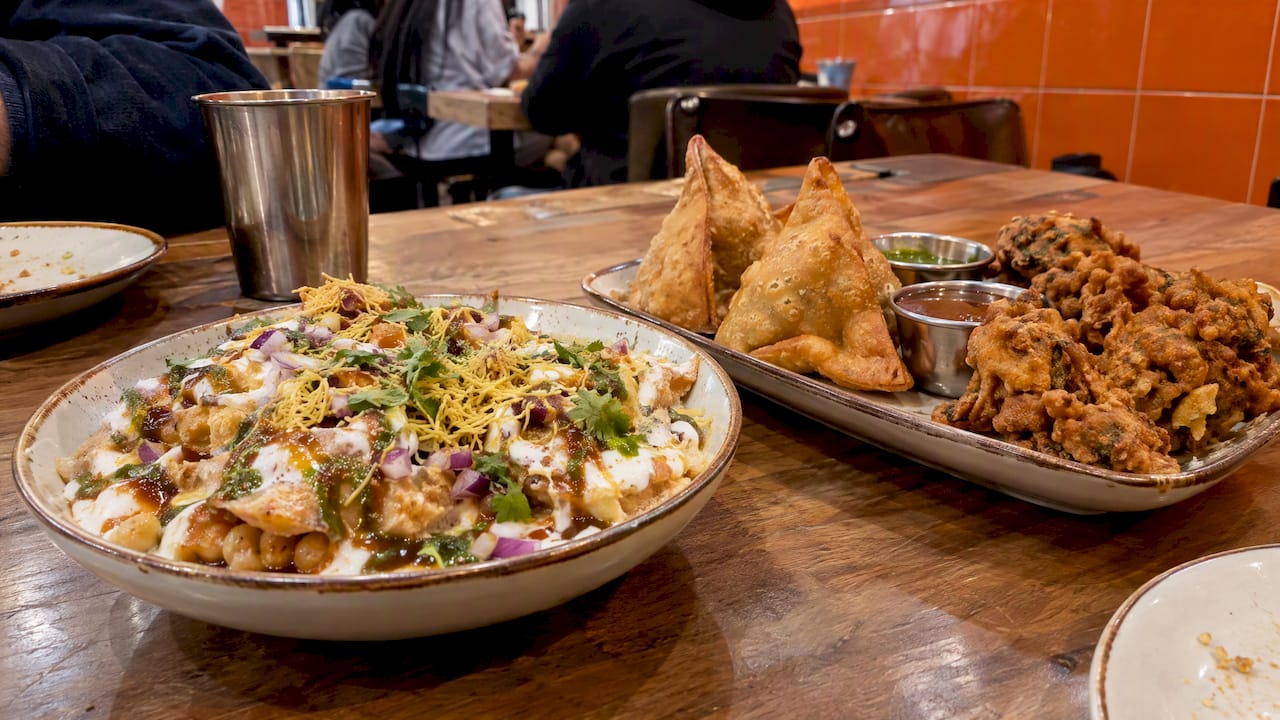
This is where we come in. We serve Indian street food in Surrey: golgappas and panipuri, chaats, samosas and pakoras, wraps and rolls, bhatura and puri, tikkas, Indian-style Chinese, South Indian dishes and a kids menu. We also list gluten-free and vegan options. You can see all of it on our full menu. If you want to know how our street food compares across the region, our piece on Indian street food in Surrey is a good start.
Serving and storing sweets safely
A table of sweets sits out for hours, and milk-based ones are perishable. Health Canada’s holiday food safety guidance sets the rules that apply:
- Keep cold foods at 4°C or below and hot foods at 60°C or above.
- Discard perishable food that has been at room temperature for more than two hours.
- Refrigerate leftovers promptly in shallow containers and use them within two to three days.
- On a buffet, give every dish its own clean serving tool, including finger foods such as nuts and candies, to avoid cross-contamination.
In practice: put out half the milk cake and gulab jamun, and refill from the fridge. Use tongs rather than hands. Dry sweets such as laddu and many barfi are more forgiving, but the same two-hour rule is a good habit for anything made with milk or khoya. Label nut-containing pieces so guests with allergies can avoid them.
Our perspective: sweets and savory belong together
We get asked at Diwali time whether we make mithai. We do not list sweets on our menu, and we would rather tell you that than pretend. What we do is street food, and we have watched how our customers use it during the festival.
The pattern is consistent. Families buy their sweets from a mithai maker, then come to us for the part of the table that is hot, fresh and shared: golgappas that guests assemble themselves, chaat plates, rolls for the kids, a tray of samosas. Street food is meant to be simple, quick and soul-satisfying, and that suits a house full of people who arrive in waves. Nobody wants to spend Diwali evening at the stove.
Our advice is to decide the savory side first, because it sets how many sweets you actually need. When there is a proper spread, guests eat fewer sweets in one sitting and take more home, which is how mithai is meant to work anyway. Keep it fresh, keep it generous and keep it affordable.
— Pooja
Catering your Diwali gathering with us
If you are hosting at home, at the office or at a community hall, we can cater the savory side of your celebration while you handle the sweets. Tell us your headcount and any dietary needs, such as vegan or gluten-free, and we will suggest a mix of chaats, snacks and mains that suits the day.
See our catering page to get started, or browse the menu for dine-in and takeaway. We do not publish catering prices, so contact us for a quote based on your event.
Dietary needs and sweets
Traditional mithai is rich in milk, ghee, nuts and sugar, so people with allergies or dietary restrictions often need an alternative plan. Some bakeries in Metro Vancouver advertise vegan, gluten-free or sugar-free desserts, but these are different from traditional mithai, so ask any maker what is actually available. If a guest has a serious nut or dairy allergy, ask the maker about shared equipment, and speak to the guest’s doctor or allergist if you are unsure what is safe to serve.
For the savory side, our menu includes gluten-free and vegan options, so those guests can eat well even if the sweets are off the table for them.
FAQ
Where can I buy ghevar in Surrey?
Several Indian sweet shops in Surrey and Delta list ghevar, but it is a seasonal specialty. Call ahead to confirm that a batch is being made and to reserve a piece or two. It is traditionally linked to Teej and Raksha Bandhan, so availability can be thinner at other times.
What sweets are served for Diwali?
The most common are gulab jamun, kaju barfi, milk cake, laddu and halwa. Families usually offer a mixed box so guests can try several. Nuts such as cashews and almonds are often given alongside.
Where can I buy traditional Indian sweets?
In Surrey you will find them at dedicated mithai shops and at Indian restaurants that also sell sweets by weight. Ask what was made that day, check for allergens and order several days ahead in festival weeks. If you need savory food for your gathering, we can help.
How long do Diwali sweets last?
It depends on the sweet. Milk-based ones should be refrigerated and eaten within two to three days, in line with Health Canada’s advice on leftovers. Dry sweets such as laddu usually keep longer, but ask the maker for their guidance.
Sources
- Mithai: What Goes into the Box of Deepavali Sweets? (Michelin Guide)
- Our Favorite Diwali Traditions (Discovery)
- British Columbians gear up for annual Diwali celebration (CBC News)
- Ghevar (Wikipedia)
- Holiday food safety (Health Canada)


